

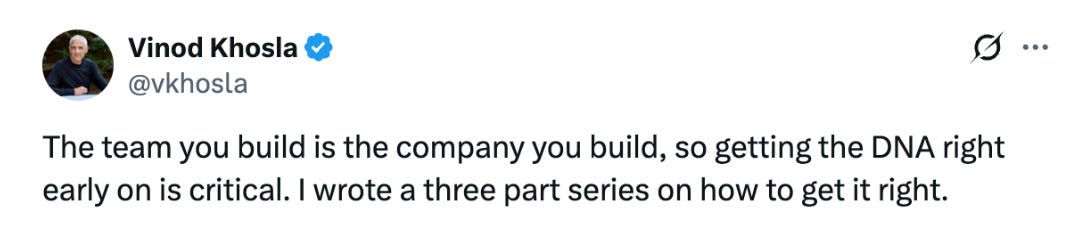
If you’re an amateur historian of Silicon Valley like me, or just someone obsessed with how innovation actually happens, you know there’s one sacred truth whispered across every legendary startup story: The founding team matters. But the first 20 hires matter even more. Just ask Vinod Khosla, a VC legend.
Those first hires don’t just build the product. They are the company. They set the culture, the velocity, the ambition, and the destiny of the startup.
For the last 50 years, the greatest companies in tech had one huge advantage that we may be about to lose forever: They were born during recessions—when the world’s best talent was suddenly available.
Microsoft (1975) — deep recession, oil crisis, stagflation
Apple (1976) — same crisis era
Oracle (1977) — recessionary stagflation
Adobe & Sun Microsystems (1982) — early 80s recession
Google (1998) — post–dot-com meltdown, Asian financial crisis
PayPal (1998) — same downturn
Facebook (2004) — post-bubble malaise
Airbnb (2008) — housing & financial crisis
Uber (2009) — global recession fallout
These companies weren’t anomalies. They were products of a very specific economic pattern that created the perfect storm for innovation. And today, AI may blow up that pattern entirely.
People often misinterpret why recessions generate great startups. They think founders had nothing better to do. They think adversity breeds grit. They think scarcity builds discipline. Those things are true but secondary.
The real reason is simpler—and far more powerful: Recessions create massive talent windfalls.
During downturns: brilliant engineers get laid off, salaries drop, hiring becomes easier, and equity becomes meaningful again
This was the secret. This was what made “recession founders” unstoppable.
Google openly bragged about it: after the dot-com crash, they were able to hire legions of smart, proven engineers cheaply. Many of those people became millionaires when Google went public.
Microsoft did the same in the 70s. Apple in the late 70s. Oracle in the 80s. Every major recession produced a generational company because the founders could recruit the first 20–50 builders at a world-class level and at a startup price. That was the engine of innovation. But now something has changed.
AI Has Broken the Talent Equation
Today, founders are increasingly complaining about the same thing:
“We can’t recruit great engineers anymore.”
Not because the engineers don’t exist. Not because the salaries aren’t competitive. But because the best talent doesn’t want to join early-stage startups anymore.
Why? Because AI has fundamentally shifted the personal economics for elite builders.
The top 1% of engineers are now saying:
“Why should I join your risky startup? I can build my own product this weekend using AI.”
This wasn’t possible in 1999. This wasn’t possible in 2009. This wasn’t possible even five years ago. AI has made it possible for a single engineer to build what once required a team, and to launch a company with near-zero upfront cost. AI didn’t just democratize creation. It eliminated the constraints that once pushed people to join teams.
The Rise of the $20–100 Million Engineer
We’re now in an era where tech giants are panicking to retain talent:
Google has quietly offered $5–10M retention packages
Meta and Apple are matching $20–50M equity grants
OpenAI and Anthropic are paying extreme premiums
Rumors of $100M compensation packages for key AI researchers are now normal
Startups are raising massive rounds just to afford a few elite hires
This is not normal. This is not sustainable. And this is not how Microsoft or Google were built. The new scarcity is elite AI-native talent—and that talent doesn’t want to join your early-stage company.
We’re at an inversion point in Silicon Valley’s history.
Old world: Recession → layoffs → talent surplus → startups hire elite people cheaply
New world: Recession → layoffs → talented people start their own AI projects → startups can’t hire them
The availability of cheap, hungry talent was the superpower that built the giants. But AI has atomized the talent pool. Now, the same conditions that used to create great teams now create thousands of micro-startups, indie-builders, and solo founders. This is the structural shift no one is talking about.
A Story Steve Ballmer Told That Sums Up Everything
I remember sitting in a marketing meeting years ago when Steve Ballmer walked in and told a story that perfectly illustrates how fragile—and how powerful—the early talent equation really was.
He said one of Microsoft’s early employees had left to start his own company in the mid-1990s. A few years later, Ballmer met him for lunch. And this former colleague—smart, driven, experienced—looked genuinely frustrated.
He told Ballmer: “Steve, I can’t replicate the talent we had in Microsoft’s first 100 people. No matter how hard I try, I cannot hire people like that again.”
Ballmer laughed and responded with what he believed was the explanation:
“That’s because Microsoft is special. The best people wanted to move to Seattle and work with us.”
But that wasn’t the real reason.
The former Microsoft employee had left to build his company at the absolute peak of the dot-com bubble in Silicon Valley—when hundreds of startups were raising money, vying for talent, throwing stock options around, and bidding salaries through the roof.
Meanwhile, when Microsoft hired its first 100 people, it was in the middle of a global recession—with layoffs everywhere, engineers desperate for work, salaries low, and job security shaky.
Microsoft did not have a magical gravitational force. It had timing. It had scarcity. It had a talent market in crisis.
The first 100 people at Microsoft weren’t just brilliant—they were brilliant and affordable. That window doesn’t exist anymore. And AI may be about to eliminate it forever.
This is the big, uncomfortable question: Can you even assemble the first 50 amazing people at a reasonable cost anymore? Because if the answer is “no,” then the classic Silicon Valley startup model is dead.
The best talent today has AI. They have compute. They have distribution. They have capital efficiency. They have infinite leverage. The world that allowed Google to hire the best people cheaply no longer exists.
AI Isn’t Killing Startups — It’s Killing the High-Talent Startup Model
Let’s be precise:
AI isn’t killing startups. It’s fueling them. It’s creating more founders than ever.
AI is killing the old high-talent model. The “20 elite hires that become the backbone of the company” model. The “cheap recession talent” model. The “build a generational team during downturns” model.
Those were the ingredients that built Microsoft, Apple, Google, Uber. That recruiting equation is now broken.
So What Comes Next?
But the era of the “high-talent recession-born superteam” that created Microsoft, Apple, Google, and Uber? That era may be gone forever.
And that is the trillion-dollar question every founder, investor, and operator needs to wrestle with.