

Last month I was at my friends Ross and Pernilla’s wedding at Kew Gardens in London. Beautiful ceremony, reception in Temperate House, the kind of day guests can’t resist posting about.
A few weeks later, I googled “ross and pernilla wedding” to try to find their wedding website.
Google’s AI Overview responded confidently: Pernilla and Ross recently celebrated their romantic wedding ceremony and reception at the Royal Botanic Gardens, Kew in London... complete with a link to Kew and a citation trail leading back to... a guest’s Instagram posts.
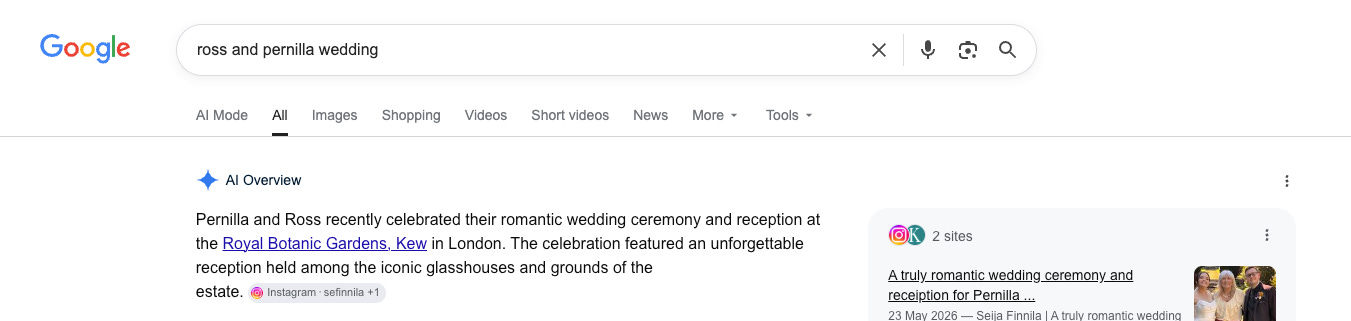
Let that sink in. Two people with no website, no press coverage, no SEO strategy, and no commercial footprint whatsoever now have a synthesized, authoritative-sounding search result. Built from a handful of social posts by their wedding guests.
The discoverability threshold just got reset. And most brands haven’t noticed.
The old threshold was brutal
For twenty years, being “discoverable” on the open web required scale. Domain authority. Backlink profiles. Years of compounding content. The SEO game was structurally winner-take-all: the top 10 results captured roughly two-thirds of all clicks, and breaking into them meant outspending or outlasting incumbents.
If you were small, new, or niche, the honest advice was: don’t bother competing on discovery. Buy ads instead.
A new threshold
AI-generated answers work differently. They construct answers, pulling from whatever signals are credible-enough on a topic. And the citation data reveals how radically that changes the game.
Evertune’s analysis of 200 million prompts found that no single domain dominates AI citations: even the most-cited domain rarely exceeds 5% of citations on any platform. The remaining 95% might scatter across thousands of domains. AI search has a long-tail distribution instead of a winner-take-all market.
Meanwhile, social content is becoming first-class source material. Tinuiti’s Q1 2026 data shows social media’s share of AI citations climbing steadily, reaching 13% for Google AI Overviews, and research from BrightEdge shows AI Overviews routinely citing Instagram, TikTok, YouTube and Reddit alongside traditional sources.
Ross and Pernilla didn’t make any conscious effort to out-SEO anyone. They simply became the key corroborated answer to a question. A couple of guest posts cleared the bar.

Why this is rocket fuel for the strategic few
Here’s the asymmetry worth exploiting: SEO rewarded accumulated authority; AI answers reward available, specific, corroborated signal. That collapses the time-to-discoverability from years to weeks.
For a startup, a local business, a niche B2B product, or a personal brand, this means:
Your category’s long-tail questions are winnable now. Nobody owns “best [your niche] for [specific situation]” in an AI answer yet. The specific beats the established.
Social is a vital source layer. Instagram posts, YouTube videos, LinkedIn articles, Reddit threads: AI systems treat all of it as citable evidence. A genuine presence in two or three of these can constitute the entire evidence base an AI draws on you.
Third-party voices matter. Notice that the wedding overview wasn’t built from anything Ross and Pernilla published, it was built from what other people said about them. Customer posts, community mentions, and guest commentary are now more structurally discoverable than ever.
Speed matters more than authority. AI systems synthesize fresh signal fast. The May 2026 wedding was in an AI Overview within two weeks. No domain-authority moat protects incumbents from a competitor who simply generates better source material, faster.
The takeaway
We used to ask: “How do we rank?” The new question is: “When an AI assembles the answer about our category, what evidence exists for it to find… and who created it?”
Two wedding guests with iPhones just demonstrated that the answer can be: almost nothing, and almost anyone.
If a handful of Instagram posts can make a private wedding discoverable to the world’s largest search engine, imagine what a deliberate strategy could do for your brand.