


A couple of weeks ago, like millions of people across the UK and Europe, I was too hot to think straight. The June heatwave broke the UK’s temperature record on three consecutive days, the Met Office issued red heat warnings for three days running (a first in the history of the current warning system) and the London Ambulance Service declared a critical incident on its busiest day ever recorded.
So, instead of turning to Google, I did what a growing share of consumers now do in a moment of urgent, high-stakes, detail-heavy purchasing: I asked ChatGPT.
ChatGPT’s Consumer Interface is Evolving…And Quickly.
ChatGPT’s shopping interface is no longer a chatbot offering vague buying advice. When I searched for the best portable air conditioners, it returned a structured product comparison: images, side-by-side prices, retailer links, and opinionated attribute rows. Best use, cooling power, noise focus, smart controls, and, most strikingly, a verdict on value for money. One product was labelled “Excellent.” Another “Moderate.” A recommendation, rendered as a table, in seconds.
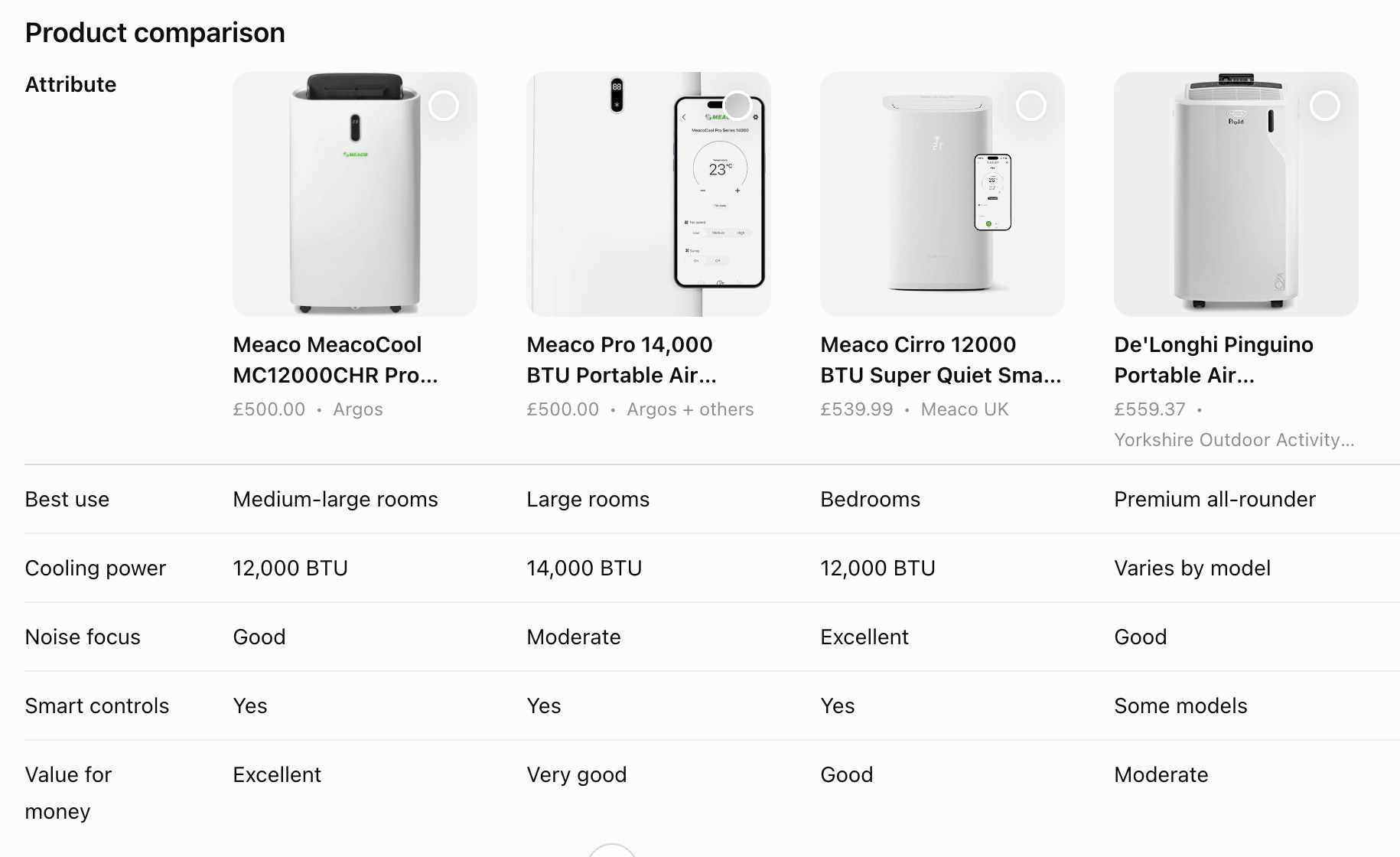
What should stop every brand and commerce leader in their tracks: of the four portable air conditioners surfaced, three were Meaco and one was De’Longhi.
Every household in the country was sweltering. Every appliance brand theoretically had a shot at that demand spike. But in the AI answer layer, the entire consideration set collapsed to two brands before I’d typed a second message.
Demand shocks are now decided by model priors
When a heatwave hits, demand for cooling explodes. Historically, that surge in demand was distributed across a messy funnel: retailer search rankings, comparison sites, Which? reviews, Amazon listings, whatever was in stock at Argos. There was lots of surface area so lots of brands could catch some of it.
However, an LLM interface like ChatGPT compresses that funnel into a single answer. And the brands that appear in that answer aren’t just chosen at the moment of the query, they were chosen years earlier, by everything the model learned in addition to everything its retrieval layer can crawl. Meaco has spent a decade accumulating exactly the assets an LLM rewards: consistent review coverage, a specialist reputation (”super quiet” positioning that literally appears as a product name), clean product data, and a direct-to-consumer site the crawler can easily read. De’Longhi brings decades of brand equity and ubiquitous retail distribution. When the model reached for “portable air conditioner UK,” these were the tokens it had.
Everyone was affected by the heat, but only a few brands were structurally positioned to be surfaced as a solution.
The Yorkshire Outdoor Activity Park problem
And then there’s the detail that reveals how early we still are. The retailer listed for the De’Longhi Pinguino? Not Currys. Not John Lewis. Not Amazon. Yorkshire Outdoor Activity Park — a real world outdoor activity venue near York and Selby where you can book to play paintball that presumably sells the odd appliance or got crawled sideways into a product feed.
It’s funny, but it’s also the whole story in miniature. The merchant layer of AI shopping is being assembled right now from whatever structured data the crawlers and commerce protocols can find. OpenAI’s Agentic Commerce Protocol lets retailers push catalogues directly into ChatGPT; those who haven’t integrated are represented by whatever the open web says about them, accurately or not. If an activity park in Yorkshire can occupy the retailer slot for a £500 De’Longhi during the biggest demand spike in UK history, the corollary is uncomfortable. A major retailer’s absence from that slot is a choice they didn’t know they were making.
What this means if you sell things
Category leadership now compounds in ways that are invisible until the moment of crisis. The heatwave revealed Meaco’s advantage. AI answer layers are winner-take-most, and the “most” is decided by years of reviews, data hygiene and specialist authority instead of campaign spend in the week demand arrives.
Your product data is now your shelf placement. Feeds, structured markup, ACP integration, crawlable D2C pages. The comparison table is built from what machines can read. If they can’t read your pages, you don’t exist… or worse, you’re represented by someone else’s account of you.
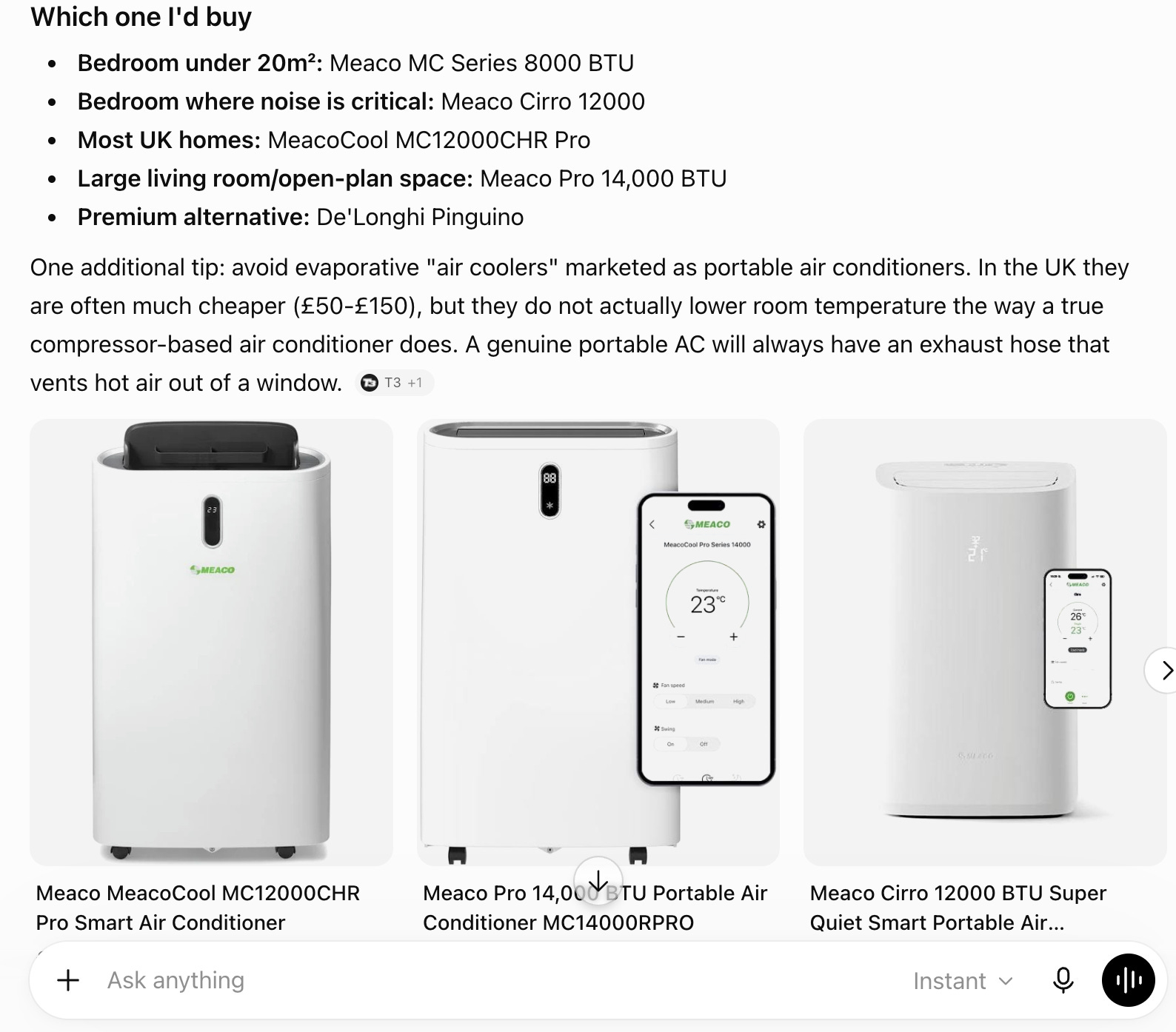
These recommendations are the new search ranking, but with a verdict attached. ChatGPT didn’t just list my options; it graded them on value for money. Brands have spent twenty years learning to influence rankings. Influencing judgements is a different discipline.
We’re in the midst of a new heatwave already. But the next demand shock, in any category, is only ever just around the corner. The question worth asking your team this week is simple: when millions of people turn to an AI in a moment of need, is your brand in the room where it happens?
The biggest shift here is not only from search results to AI answers.
It is from visibility to pre-framed trust.
A search page gives the buyer options.
An AI answer increasingly tells the buyer which options deserve consideration, what they are good for, and whether they represent value.
That means the brand is not entering the comparison neutrally.
It is entering with a judgment already attached.
Reviews, specialist authority, and clean product data are no longer just discoverability assets.
They are part of how the buyer’s confidence is formed before the brand gets a chance to speak.