

Over the past six years, Nike made a high-stakes bet on Direct-to-Consumer (DTC) retail. To force buyers onto their app and website, they deliberately severed long-standing wholesale relationships and scaled back traditional brand advertising. Commercial execution was rocky, to put it mildly. Revenue took a direct hit, retailers felt abandoned, and industry analysts continue to debate whether Nike can successfully recover its lost retail footprint.
Yet, embedded in this strategic stumble is an unexpected triumph: Nike quietly built one of the most dominant organic search engine and generative AI positions in modern e-commerce.
While retail execution faltered, their digital visibility exploded. On both traditional search engine result pages (SEO) and artificial intelligence answer engines (GEO, or Generative Engine Optimization), Nike is running away from the field.
The Metrics: Nike vs. Adidas
To understand the scale of Nike’s search dominance, consider how they measure up against their fiercest global rival.
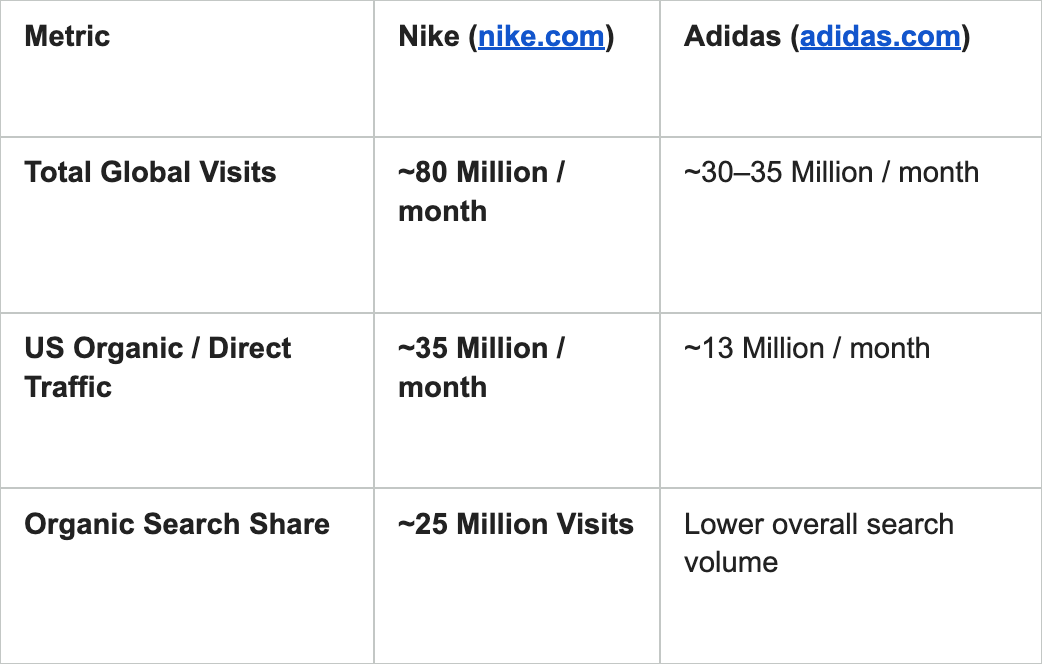
In the U.S. alone, Nike commands nearly three times the organic traffic of Adidas. A massive portion of this pipeline feeds directly through non-paid organic queries—proving that consumers aren’t just bumping into Nike via ad placements; they are actively searching for and finding Nike products first.
How Nike Built Its Search Moat
Nike’s search dominance didn’t happen by accident. It is the cumulative result of four deliberate, long-term technical and content decisions:
Strategic Site Consolidation (The 2015 Shift)
Prior to 2015, Nike operated a sprawling web of regional web properties, store locators, and microsites. By centralizing everything into a single, high-authority domain (nike.com), they consolidated nearly two decades of accumulated domain authority into one single property. Every link earned anywhere in the world now lifts the entire catalog.Technical Directory & Mobile Architecture (2015–2020)
During their peak mobile push, Nike heavily overhauled their category trees and dynamic page filtering. Their clean taxonomy allows search engine crawlers to parse thousands of product variations, sizes, and colors without tripping over duplicate content or bloated URL parameters.“Athlete Intent” SEO
Nike anchored their keyword strategy around cultural authority, specifically, high-intent searches tied to global brand ambassadors. Queries like LeBron James basketball shoes or Air Jordan release dates drive huge organic volume. Nike optimized landing hubs directly around these athlete entities, capturing intent long before a user decides on a specific shoe model.High-Trust E-E-A-T Content
More recently, Nike leaned into authoritative, context-rich content, training schedules, gear breakdowns, and athlete-curated routines. Search engines evaluate websites based on Experience, Expertise, Authoritativeness, and Trustworthiness (E-E-A-T). Nike’s brand ambassador integrations deliver proof of authority that smaller brands simply cannot buy.
A Warning for Nike’s Turnaround Strategy
Generative Engine Optimization isn’t a secret code for tricking AI models; it is the discipline of structuring brand facts, entities, and product information so clearly that an LLM can parse and recommend them without confusion. When you build clear entity associations—linking LeBron James to specific footwear tech or sports categories to precise gear guidelines—both AI models and traditional Google spiders recognize your domain as the primary source of truth. In short, If you practice good GEO, excellent SEO naturally follows.
Nike now stands at a critical juncture. Executive leadership is actively working on an operational turnaround, re-engaging wholesale distributors and recalibrating brand spend to recapture lost retail revenue.
That shift is necessary, but it comes with a major risk: don’t dismantle the digital foundation in a rush to fix traditional channels.
Nike’s DTC push caused real commercial pain, but it also forced them to build a best-in-class digital ecosystem across SEO and GEO. As leadership re-opens physical wholesale channels, they must protect the technical infrastructure, content hubs, and authority engine they built over the past decade. Discarding their digital footprint while fixing wholesale would be a far worse mistake than leaving wholesale was in the first place.