


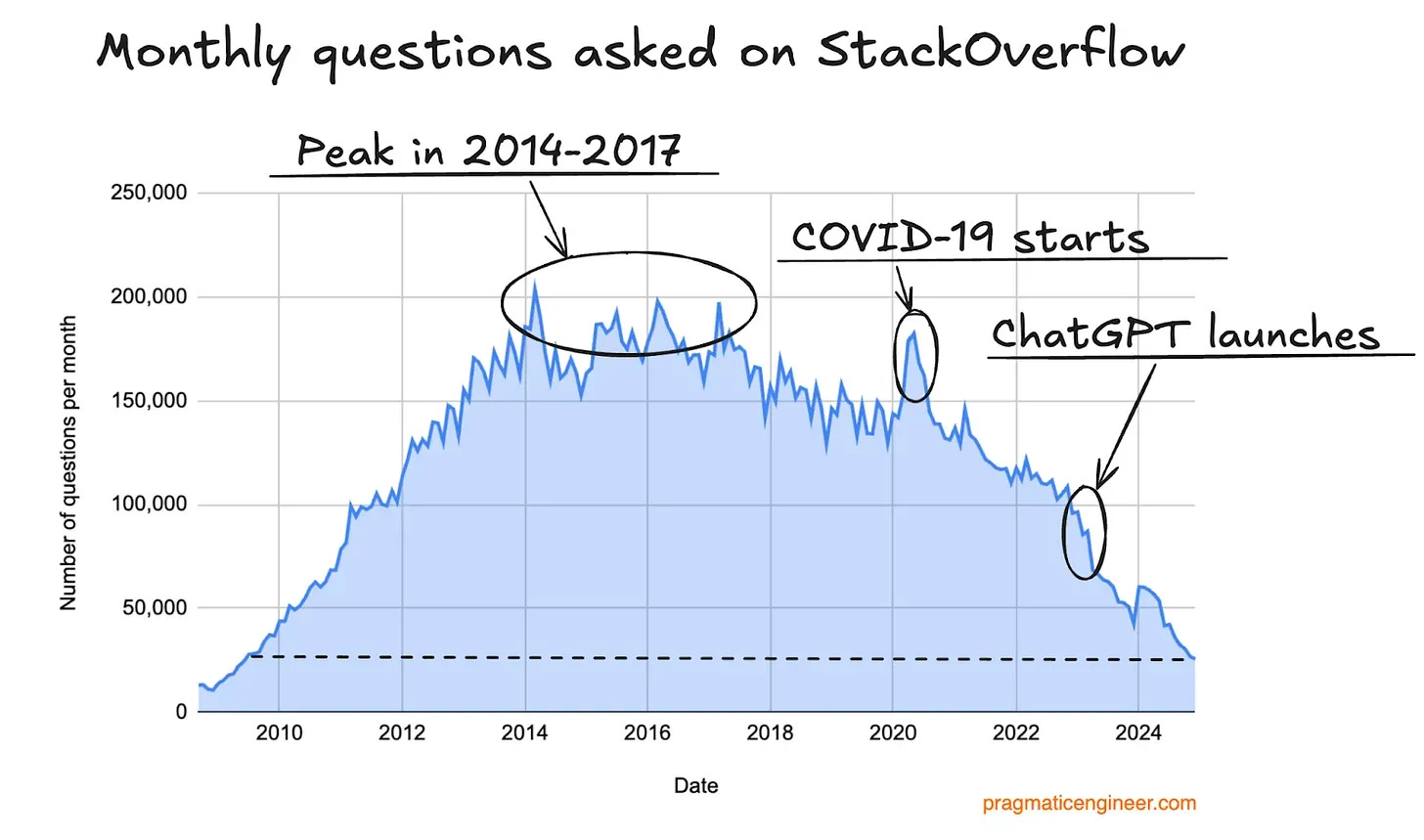
If you look at the chart below, it shows how many questions are being asked on Stack Overflow over time. What should stop you cold is this: the number of questions being asked today is lower than what was being asked back in 2009, the year the site launched.
That’s not a dip. It’s not a cyclical slowdown. It’s a structural collapse of a business that had 60 million questions on its site and at its peak, over 110 million visitors per month!
For more than a decade, Stack Overflow was one of the most important sites on the internet for developers. If some code wasn’t working, if a database wouldn’t sync, if an algorithm was throwing an error, you didn’t think twice. You typed the problem into Google, clicked the Stack Overflow result, scrolled through a handful of answers and comments, tried a few snippets, and eventually found the fix. It saved enormous amounts of time. It was a real utility.
And almost all of that utility was distributed through one channel: Google search.
That detail matters, because Stack Overflow didn’t lose because it became worse. The content didn’t suddenly get bad. The community didn’t disappear. Developers didn’t stop needing answers. What changed was the interface to knowledge itself.
For years, the flow was simple and predictable: search, click, read, solve. Stack Overflow lived entirely inside that flow. SEO wasn’t a growth channel for them; it was the business.
Then large language models showed up.
When LLMs first started gaining traction, Stack Overflow wanted to be early. They opened the doors and allowed these models to crawl their entire knowledge base—more than sixty million technical questions and answers collected over a decade. Not long after, they went further and created direct APIs so LLMs could access that data even more cleanly.
The assumption was obvious, and in hindsight, disastrous. They thought this would work the same way Google did. A user would ask a question in an LLM, the model would say the answer came from Stack Overflow, and traffic would flow back.
But LLMs don’t behave like search engines. They don’t need to send users anywhere. They learn from the data, combine it with everything else they’ve seen, and deliver an answer immediately. Stack Overflow didn’t get replaced. It got absorbed.

Developers, who are some of the fastest adopters of new tools, noticed right away. They realized they no longer needed to carefully phrase a Google query, open multiple tabs, and sift through comment threads hoping one answer would work. The LLM just gave them the answer, right when they needed it. No friction. No clicking. No hunting.
Then Google AI Overviews arrived and finished the job. Even engineers who stayed in Google started getting answers directly on the results page. There was no longer a reason to click into Stack Overflow at all.

Once that happened, the flywheel broke. Fewer visits meant fewer questions. Fewer questions meant less community engagement. And less engagement meant even fewer reasons for anyone to show up in the first place. The chart tells that story better than any opinion ever could.
At its peak, Stack Overflow was valued around $1.8 billion. Less than three years after LLM adoption accelerated, the company is now struggling to figure out what its role is in this new world. That speed should scare you, because this didn’t take a decade. It happened almost overnight.
This is where the warning extends far beyond developers.
If you’re a brand or a company that relied heavily on SEO—if eighty percent or more of your traffic came from search because you built a great content engine—you are exposed. Today, a majority of searches don’t result in a click at all. LLMs and AI Overviews are answering questions directly, and users are perfectly happy never visiting the source.
Stack Overflow made the situation worse by giving away its proprietary data for essentially nothing. If your data is your product, you can’t hand it over and expect distribution to save you. In retrospect, they might have been better off saying, “Buy us, and you get the data.” Instead, the data became training fuel, and the destination became irrelevant.
This lesson isn’t limited to technical communities. Review sites, comparison engines, travel blogs, health explainers, and financial content businesses are all built on the same premise: people come to us for answers. Once the answer no longer requires a visit, the entire model collapses.
A lot of people want a neat ending here. A tactic. A smarter version of SEO. The uncomfortable truth is that there isn’t one. SEO as a primary business model is dead. Stack Overflow is simply the clearest early example of what happens when answers stop producing clicks.
What matters now isn’t ranking. It’s brand, and having an AI Optimization (AIO) playbook that works for agentic commerce, high visibility in answers to relevant queries, citations, etc. It’s also having users who come to you directly because they know who you are, not because an algorithm routed them there. That means memberships, accounts, communities, and in some cases closed or partially walled gardens. It means building something sticky enough that people choose you by name.
For years, many companies coasted on the idea that SEO traffic was enough, that brand could come later. That era is over.
Developers just got there first. Other industries will follow. Stack Overflow didn’t fail because it was bad. It failed because SEO was its cash cow, and when that cash cow died, there was nothing underneath it.