I’ve been through a lot of Google updates over the years.
I was around for Panda in 2011, when Google went after content farms and SEO spam. Then Penguin in 2012, which focused heavily on unnatural linking, keyword stuffing, and web spam. Back then, the internet was flooded with people trying to game the algorithm, and Google’s job was to clean it up.
Then came some of the biggest updates I personally saw impact the industry: Hummingbird and Pigeon in 2013 and 2014.
Hummingbird fundamentally changed Google’s core algorithm and pushed search toward semantic understanding instead of simple keyword matching. Pigeon dramatically improved local search and changed how businesses ranked geographically.
But here’s the important thing people miss when they look back at these updates:
Every major Google update historically followed a shift in user behavior. The early updates cleaned up desktop SEO spam. Then between 2015 and 2022, the focus shifted heavily toward mobile.
Mobilegeddon in 2015 basically told the world: if your website isn’t mobile-friendly, you’re not going to rank well anymore. Even on the desktop.
Then BERT in 2019 pushed Google even further into understanding context, intent, and natural language, especially on mobile experiences. Google spent almost a decade telling businesses: If you’re not optimized for mobile, you’re eventually going to lose visibility everywhere.
Now we’re entering the next era. And this recent core update made it very clear that if you’re not optimized for AI, then forget about SEO!
We’re Moving From a Mobile-First Internet to an AI-First Internet
The updates Google rolled out between February and April 2026 weren’t random volatility. This reminded me a lot of Panda and Penguin all over again. The focus now is AI spam instead of desktop spam.
More specifically: mass-produced, low-effort, AI-generated content. A lot of major publishers jumped onto the AI bandwagon over the last 36 months. They started scaling content production aggressively using AI-generated reviews, summaries, comparison pages, and thin informational articles. And during this update cycle, many of those sites got crushed.
We saw pages that historically ranked extremely well suddenly drop 20–30% or more, especially review sites and thin-content publishers where you could clearly tell the content lacked originality, firsthand expertise, or real value. Why? Because Google is prioritizing something very different now.
Google Is Rewarding Originality Again
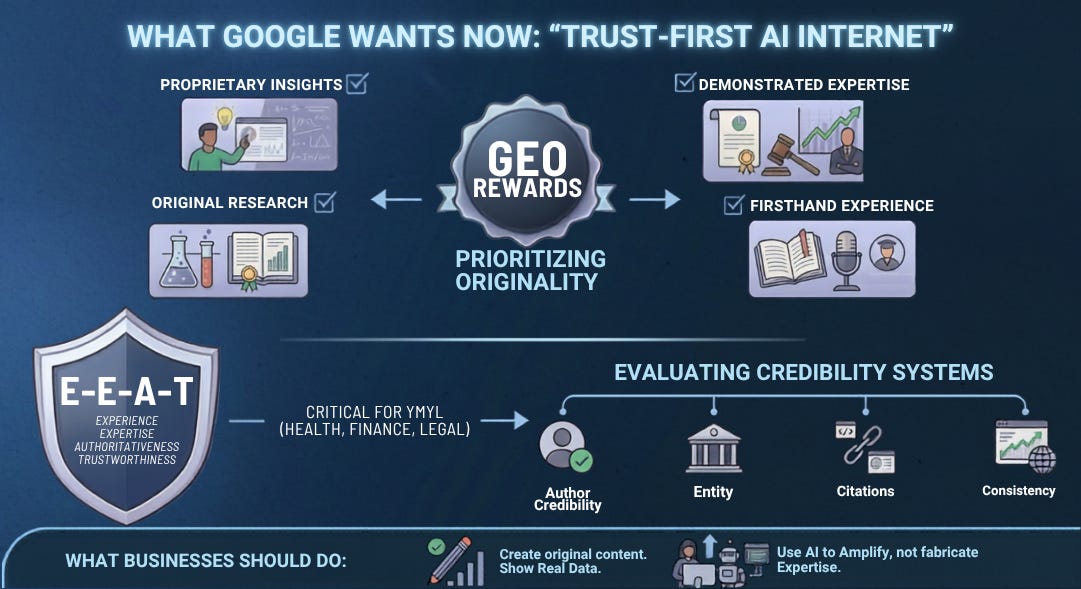
What Google wants now is:
proprietary insights
original research
firsthand experience
demonstrated expertise
real credibility
If you’re a researcher, operator, doctor, lawyer, investor, founder, engineer, or actual practitioner with firsthand experience and unique data, you now have a massive advantage over generic AI-generated content.
That’s the shift. For years, SEO rewarded scale. Now GEO rewards credibility. And the industries that got hit the hardest during this update were YMYL categories: Your Money or Your Life - Health, Finance, Legal.
Why? Because Google does not want AI-generated fluff giving people medical advice, financial advice, or legal guidance without real expertise behind it.
That’s where E-E-A-T becomes critical: Experience. Expertise. Authoritativeness. Trustworthiness.
And honestly, this is probably just the beginning. That means the future winners are not going to be the companies producing the most content. The winners are going to be the companies producing the most trusted content.
And trust now extends beyond your website.
Google and AI systems are increasingly evaluating:
author credibility
entity authority
citations across the web
consistency across platforms
original data
real-world expertise
user trust signals
In other words: Google is no longer just ranking pages. It’s evaluating credibility systems.
What Businesses Should Do Going Forward
Honestly, the strategy is pretty simple.
Create original content. Show real data. Publish firsthand experience. Stop mass-producing low-effort AI pages hoping to rank. Use AI to amplify expertise, not fabricate it.
The latest core update confirmed exactly where Google is heading next. We’re moving from an SEO-first internet to a trust-first AI internet. The businesses that understand that early are going to dominate the next decade of search, AI Overviews and beyond.