


The Fastest Rise and Fall I’ve Ever Seen in Tech
Not even two years ago, the loudest voices in tech were predicting that AI-generated content would reshape media forever. The talking points were everywhere:
AI will replace writers.
AI will publish better, faster, and cheaper.
Companies will flood the web with limitless content.
For a brief moment, people actually believed this. Agencies spun up “AI content factories.” SEO teams bragged about generating tens of thousands of pages a month. Marketers automated newsletters, product reviews, recipes, and how-to guides. The internet became flooded with generic, repetitive, low-value AI text.
For a minute, I felt like a dinosaur about to go extinct. Would AI really replace the strategies I have been using for decades?
But what happened is the exact opposite of what the hype predicted.
AI didn’t kill writers. AI killed the value of AI-generated writing.
And the distribution platforms—Google, Bing, ChatGPT, Perplexity—responded accordingly: They began suppressing and deranking AI-generated content across the board.
In 20 years of working in search and content, I have never seen a hype cycle rocket upward so fast and then crash to earth even faster. Entire SEO strategies built on AI content are now dismantling themselves in real time. Traffic is down 40–90% for many publishers. Some have shut down completely.
The “AI content revolution” never actually happened.
Why Google Is Rejecting AI Content
Google’s response is the main driver of this collapse. They have four core reasons for systematically rejecting the content farms built on large language models.
1. AI Content Is High-Noise, Low-Value Pollution
Google’s mission has never changed: Provide the best answer.
AI-generated content, especially at scale, does not do that. It floods the web with derivative, shallow summaries of existing information. It’s not original. It’s not based on real experience. It doesn’t include proprietary data. It’s simply text that looks like real text but isn’t.
To Google, this is just the 2025 version of article spinning, programmatic SEO, content farms and keyword stuffing Spam by another name. And Google’s ranking systems were built to kill spam.
2. Google Can Detect AI Content Easily
Contrary to popular belief, Google doesn’t need clumsy “AI detectors.” It simply looks for consistent, unnatural fingerprints that betray mass production:
Token predictability
Templated paragraph structures
Machine-like rhythm and synthetic phrasing
Lack of contradictions or genuine nuance
Absence of first-hand experience
Sudden, unnatural page growth
Google can spot this instantly. Even if the writing is “good,” the automated pattern of mass production gives it away.
3. Google Wants EEAT — Something AI Cannot Fake
Google has doubled down on its four core quality signals: Experience, Expertise, Authoritativeness, and Trustworthiness.
AI possesses none of these. If your content has no real author, no real experience, and no real point of view, Google now treats it as low-value filler.
4. The Result: Google Penalizes AI Content
Below is a live screenshot posted publicly by SEO expert Gagan Ghotra, showing exactly what Google does when a site scales aggressively with AI-generated content:
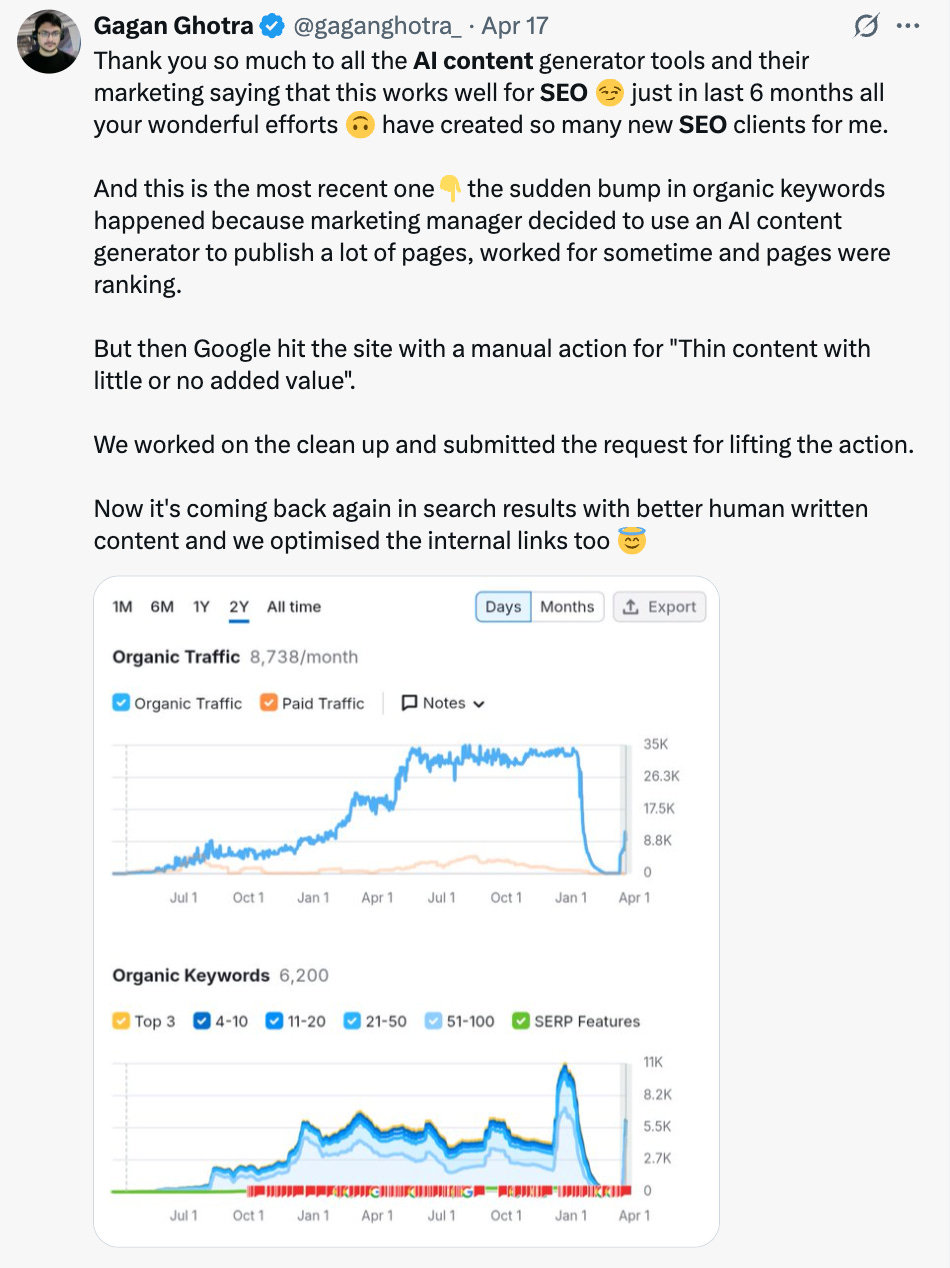
Here’s the pattern you see again and again in the data:
AI pages go live → rankings spike briefly.
Google detects the pattern → manual or algorithmic action is applied.
Traffic collapses overnight.
Site only recovers after removing the AI content and replacing it with human writing.
This isn’t an anomaly. It is now the default outcome.
5. AI Content Competes With Google’s Business
This is the harsh economic reality: Google has no incentive to reward AI content when Google can answer the question itself via AI Overviews.
Why would Google send traffic to 10,000 AI-written “Best things to do in Miami” pages when Google can simply display the best answer?
AI content doesn’t support Google’s business. It cannibalizes it. So Google suppresses it.
Why LLMs Are Rejecting AI Content Too
This part is even more devastating for publishers because the rejection is coming from both ends of the consumption chain.
1. LLMs Can’t Train on AI Content Without Collapsing
If ChatGPT, Gemini, or Claude train on AI-generated text, the models degrade. This is known as model collapse. Creativity collapses. Reasoning collapses. Outputs become more predictable and less accurate.
AI-generated text is poison to LLMs. So they actively filter it out of their training data.
To put this in layman’s terms, LLMs need real word data and human inputs (real writing, etc.) to be able to train accurately. If the LLMs training data is just other AI generated content, then the LLMs cannot learn and adapt from how humans actually use words in context. After several iterations, they actually start to degrade in quality. This is why you hear so much about LLMs going out of their way to filter out any AI generated content on the web.
2. LLMs Already Have Better Sources
AI content farms imagine that their articles will be “indexed” and valued by LLMs.
But LLMs prefer high-quality, proven sources:
Books and scientific papers
Trusted news and academic research
Expert summaries and real human-written sources
AI content adds nothing. It’s noise, not signal.
3. LLMs Replace Content — They Don’t Send Traffic to It
This is the paradigm shift that caught everyone off guard. When users ask, “How do I unclog my sink?” or “What should I do in Chicago?”, LLMs answer directly. They don’t send the user to a website.
AI content is training the system that eliminates the need for publishers. It’s the most ironic self-own in the history of content.
Conclusion: AI-Generated Content Is Already Dead
The next decade belongs to content that AI cannot fake:
Proprietary data and original research
Lived experience and niche expertise
First-party signals and community-driven content
Human storytelling and personal insights
Unique visuals, audio, or video
Everything else is noise. And the new winners will be the ones producing what AI cannot replicate: real expertise, real experience, real insight, and real action.