


“The Ads are coming!” “The Ads are coming!”
Unlike Paul Revere’s midnight ride warning colonists of approaching British troops during the American Revolutionary War, the arrival of ads in LLMs like ChatGPT can hardly be considered a surprise.
This has been less a shock announcement and more the worst-kept secret in AI.
While OpenAI took its time to make a formal announcement about introducing advertising into ChatGPT, the company’s leadership has repeatedly acknowledged the possibility. CEO Sam Altman has addressed the topic publicly on several occasions. Speaking at Harvard Business School, Altman described the combination of advertising and artificial intelligence as “uniquely unsettling” while conceding that ads could become a “last resort business model” if required. Last resort indeed.
He later expanded on this during an episode of the OpenAI podcast, noting that the company is open to experimenting with ads. Since then, OpenAI has confirmed that ads will appear at the bottom of responses in free and entry-level paid tiers, while higher-priced subscriptions will remain ad-free.
Altman has consistently stressed that any advertising would need to be carefully integrated to avoid undermining user trust. Early tests have included app suggestions and other promotional placements. OpenAI has since confirmed that ads are being tested and will be clearly labeled, without influencing the model’s answers, for now. So amidst a fog of uncertainty, let’s try to answer some of your burning questions.
Why Are Ads Coming?
Two key reasons.
First, economics.
Running frontier AI models is extraordinarily expensive. Training, inference, infrastructure, and talent costs continue to rise. A Bloomberg-linked estimate suggests that, by 2029, OpenAI might need approximately $125 billion in annual revenue just to break even given its projected cost structure and expansion plans.
Second, scale.
ChatGPT has grown into one of the largest consumer platforms in history. It is reported to have roughly 900 million weekly users, up from about 100 million in late 2023 and approximately 300 million in late 2024. OpenAI has publicly discussed ambitions to reach 2.6 billion weekly active users by 2030. At that scale, ChatGPT represents an enormous advertising opportunity.
How Might Ads Appear?
Several formats are possible, and OpenAI has now clarified how ads will initially be presented.
In their first iteration, ads will appear at the bottom of ChatGPT’s responses in the free tier and the cheapest paid plan, ChatGPT Go, and will be clearly labeled.
Over time, richer formats may emerge. Ads could surface as contextual recommendations presented alongside AI-generated responses, such as suggesting a specific hotel or product during a travel query about Sicily. They could also resemble traditional sponsored links, similar to those seen in Google search results, or appear as product carousels alongside answers.
The precise approach will matter. Poorly aligned recommendations risk breaking the illusion of neutrality that makes conversational AI compelling in the first place.
When are ads coming?
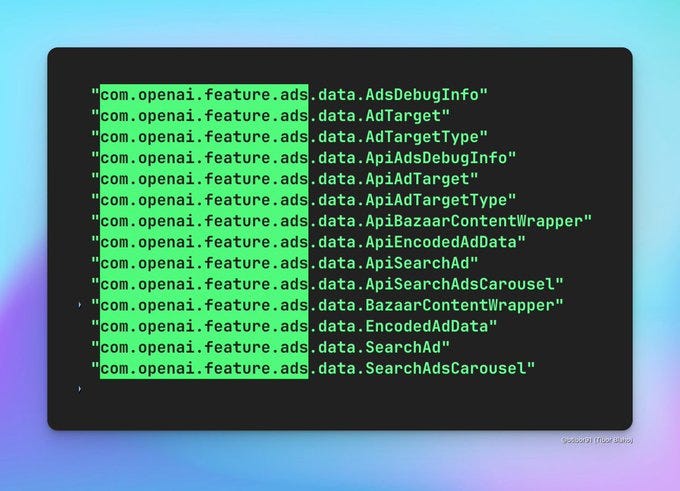
In many ways, they’re already here. Testing is now underway. OpenAI has confirmed that ads are being trialed within ChatGPT ahead of a broader rollout. OpenAI has reportedly been experimenting with ad-related code and features in beta versions of its apps for some time prior to the announcement.
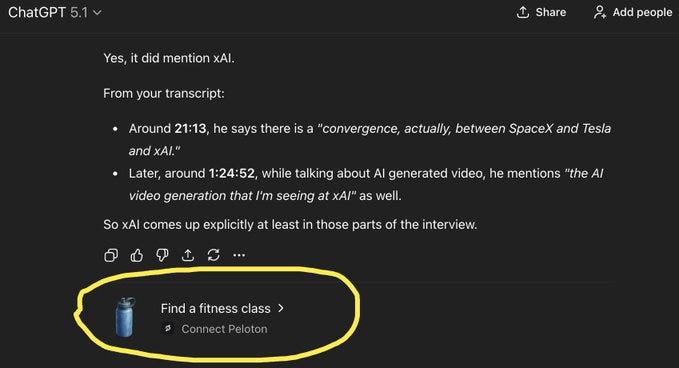
Developer Kol Tregaskes recently shared an example on X that captured user frustration. The screenshot showed a ChatGPT Pro session displaying an app suggestion to “Find a fitness class” using Peloton, despite the user not asking about fitness or Peloton at all. The recommendation appeared disconnected from the conversation. OpenAI has since said such tests do not reflect its intended long-term ad experience.
For now, higher-priced tiers remain ad-free, but that status is unlikely to persist for long.
Which ChatGPT Tiers Will Be Affected?
OpenAI has now confirmed that ads will appear in the free tier and its lowest-cost paid plan ChatGPT Go, while higher-priced subscriptions, including Pro, will remain ad-free. This is hardly a surprise. The free tier of ChatGPT already includes usage limits, and ads would provide an additional revenue stream to support the platform. The more sensitive question concerns paid users.
Pro subscribers paying $200 per month may understandably object to seeing ads in a premium product. With the cheapest subscription tier the first to fall, they have come for ChatGPT Go users, and many will not speak out because they are Pro users. But when they eventually come for Pro users, they may well find that there is no one left to speak for them. Ultimately, whether ads appear in paid tiers will likely depend on how intrusive they are and how clearly they are differentiated from organic responses.
How Will AI Ads Differ From Traditional Online Advertising?
OpenAI has signaled two key principles.
Conversational integration.
Ads are expected to feel like part of a helpful response rather than obvious banners or interruptions.
Trust preservation.
So far OpenAI has said ads will not influence responses and will not be shown to those under the age of 18. Conversations will not be sold to advertisers, sensitive topics such as politics and mental health will be excluded, and users can opt out of ad personalisation. According to Sam Altman, advertising must not corrupt rankings or compromise the model’s perceived objectivity. User trust remains the platform’s most valuable asset.
So here’s the bottom line: Ads in ChatGPT are inevitable, driven by cost pressures and massive scale. The real question is whether OpenAI can introduce them without damaging the trust that made ChatGPT valuable in the first place.